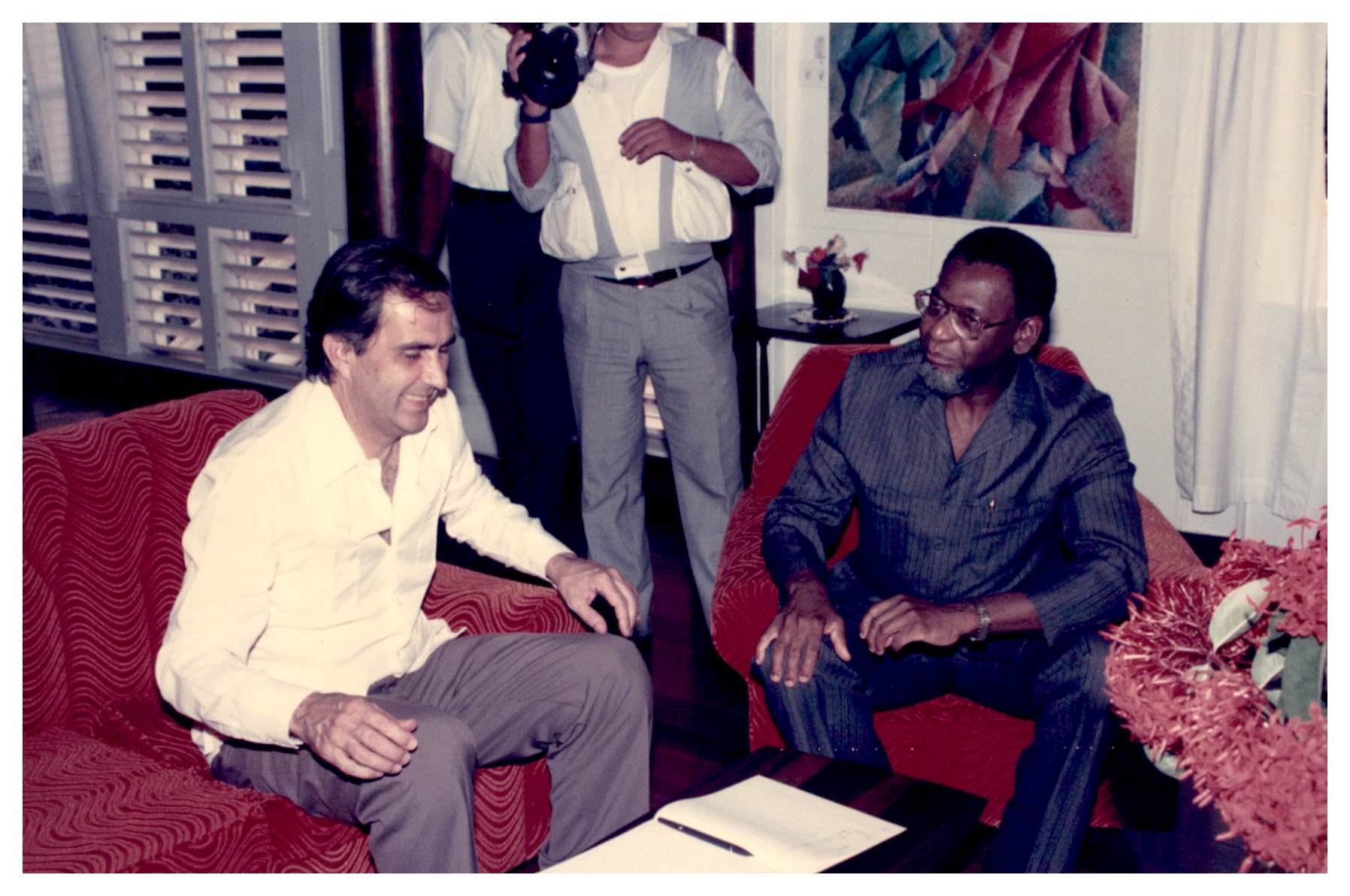
As we reflect on the life and work of former CARICOM Secretary-General Roderick Rainford, OCC, who died recently, we revisited our archives and uncovered a feature in which he reminisced about the significance of Colgrain House, the official residence of six Secretaries-General. Mr. Rainford graciously participated in a virtual interview with the Communications Unit for this article, originally published in the December 2012 edition of the CARICOM View magazine to usher in the Community’s 40th anniversary in 2013.
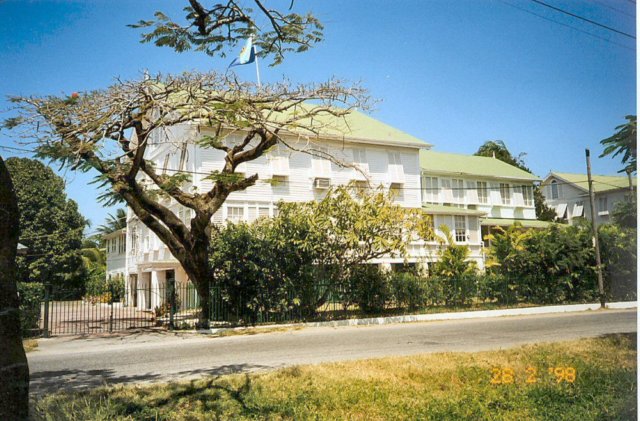
The sheer size of the imposing colonial structure at once impresses and intimidates. The Demerara shutters running around its perimeter, so typical of the architecture of that era, seem to be one of its most compelling features.
Overlooking the tree-lined avenue on Camp Street in Georgetown, Guyana, the magnificent, historic, wooden edifice is the place six Caribbean Community (CARICOM) Secretaries-General called home for a period of forty years.
Colgrain House, once the home of sugar magnate, Jock Campbell, was an integral component of the regional integration movement from the Community’s inception. Back in July 1968, it housed both the administrative offices of the Caribbean Free Trade Area (CARIFTA) – the precursor to CARICOM – as well as the residence of its Secretary-General, Mr. Fred Cozier. Secretaries-General William Demas, Alister McIntyre, Kurleigh King, Roderick Rainford, and Edwin Carrington, also resided there.
Hesitant about Colgrain
For Mr. Roderick Rainford, who, in 1983, became Secretary-General, Colgrain House held a special place in his heart as he tied the knot there in a small civil ceremony in 1992. By then, he had become accustomed to the sprawling, intimidating home he had moved into from his modest residence in New Providence on the East Bank of Demerara.
“When I became Secretary-General, I was hesitant to go to Colgrain House because of its size. It was huge! After I overcame that initial hesitation and moved in, I got around to enjoying it immensely,” he recounted with amusement, during an interview in 2012.
Giving an indication of the size of the property, Mr. Rainford recalled that the Secretary-General’s bedroom was a huge area that, in his estimation, could have been divided “into about three bedrooms”.
“What I particularly enjoyed were the Demerara windows. I enjoyed opening up those windows upstairs and downstairs and having the benefit of the cool breeze blowing through the building. The only (problem) was closing them back up in the evenings! I used to enjoy the nice, long veranda facing Camp Street,” Mr. Rainford recalled of his time at Colgrain.
The Demerara shutters, he said, were a “fantastic Guyanese invention” and it would be a pity if the “charming structures were replaced by concrete boxes”.
He took pride in ushering visitors – among them Heads of State – around the home, and showing off its collection of paintings.
“It was always enjoyable to take visitors around to show off the paintings. With the passing of the years and the weather some of the paintings were deteriorating and I had a competent artist retouch some of them to give them a new lease on life,” he said.
Mr. Rainford was also drawn to the grounds of Colgrain House. He planted and nurtured fruit trees there, among them two sapodilla trees. A self-confessed “great lover of sapodilla”, the former Secretary-General planted the trees after enjoying “some delicious sapodillas. They were so sweet that I put the seeds in some little pots, selected the best two and planted them.”
He remembered the mango trees that he found there and the avocado tree “at the foot of the stairs of the back entrance to Colgrain”.
“But there was a problem with that tree. Every year, it would blossom and bear, but the fruit would fall off while they were still young. An agronomist came and did something to it and forever after that, I was getting the most delicious pears. Whatever magic he worked, he fixed it!”
Mr. Rainford had fond memories of entertaining staff members and other guests at the official residence.
“There was a time when, as part of the practice of keeping in touch with the staff, we would have open house, once each month on a Saturday afternoon, where all staff who wished to, attended. We divided the staff into four and had open house for a quarter of the staff so that by the end of the year, all staff members would have had the chance to come to the social gathering… Anita used to cook some delicious cook-up, with chicken. A good number would turn up. I suppose those who didn’t come were those who were quarrelling with the Secretary-General. There was the time too when, after each Heads of Government Meeting, the press would come to Colgrain House for a post-Heads of Government press conference. It was a good gathering.”
Colgrain House was also open to guests for the traditional CARICOM Day reception.
“Since we were normally out of Guyana, we would have the CARICOM Day reception not on the Fourth of July, but the first available opportunity after the Heads of Government Meeting,” he recalled.
Mr. Rainford also recalled that International Bars were among the events for which the premises were made available.
“St John’s Ambulance Brigade used to hold them. The Secretary-General would make the premises available for the holding of international bars. So, he would simply make the premises available, then retreat into the upper echelons of the house and hide away until they were finished,” he said.
For those who have had the good fortune of living and/or working at Colgrain House, the grandeur, historicity and symbolism are etched in their psyche. For them, the great house holds great memories.