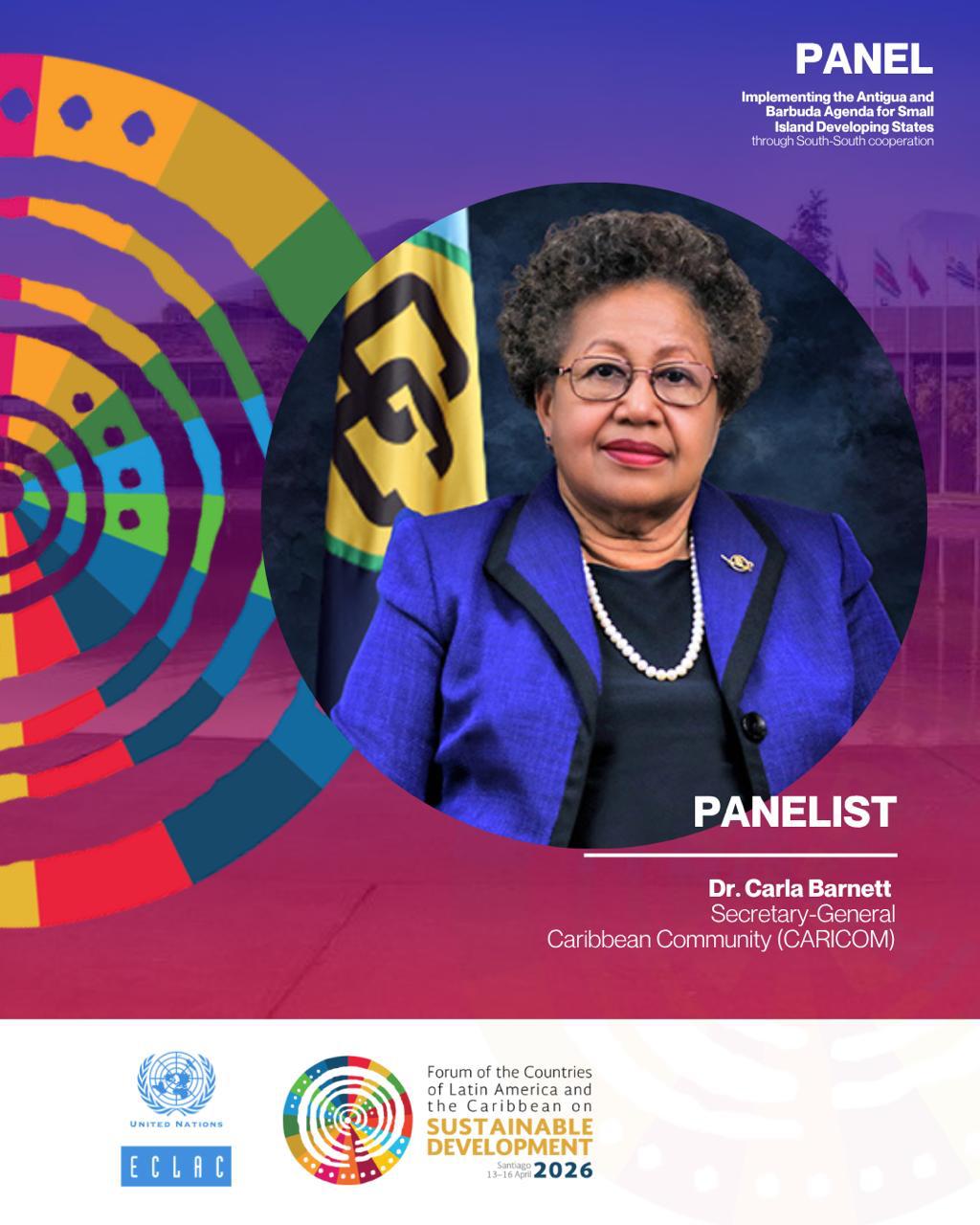
“South-South cooperation, including SIDS-to-SIDS cooperation, and triangular cooperation are important means of implementation for the Antigua and Barbuda Agenda for SIDS. They provide opportunities for knowledge-sharing, capacity building, technology transfer and solidarity among developing countries, and should be strengthened to support the achievement of resilient prosperity in SIDS.”- Para 32J Antigua and Barbuda Agenda for SIDS (ABAS)”
Beneficial implementation of the ABAS does not require new declarations. What it requires is effective, regionally grounded implementation. We in CARICOM face complex interlinked challenges of climate vulnerability, debt sustainability, narrow production bases, and high exposure to exogenous shocks. Operationalisation of the ABAS, especially in the current geo-political context, cannot rely primarily on traditional North–South cooperation modalities. South–South cooperation, and SIDS-to-SIDS partnerships in particular, are uniquely positioned and necessary to advance implementation of the ABAS. This implies leveraging shared experiences, coordinating and mutually supporting implementation in a context of regional solidarity to address common challenges such as climate vulnerability, economic diversification, and social inclusion.
There are several ways we are seeking to do this in CARICOM at this time:
- Through Shared Knowledge and Capacity Building– Caribbean SIDS can expand learning from each other’s innovations in renewable energy, disaster risk reduction, and sustainable tourism. In one ongoing example from the Energy Sector, collaborative South‑South and triangular cooperation, CARICOM, SIDS DOCK, and the United Nations Industrial Development Organization (UNIDO) support sustainable energy goals across the Caribbean. In CARICOM-specific examples, the Caribbean Centre for Renewable Energy and Energy Efficiency Centre (CCREEE) and the University of the West Indies (UWI) provide training, knowledge‑sharing, and capacity development in e-mobility, in regulations and planning workshops, and renewable energy technologies.
- Technical Cooperation– Pooling expertise in areas like fisheries management, coastal protection, and digital transformation reduces reliance on external consultants and builds local capacity. Examples of this are the CARICOM Hub for the Capacity Building Programme related to Multilateral Environmental Agreements in Africa, Caribbean and Pacific Countries (ACP MEAs) Project and the CARICOM Technical and Scientific Cooperation Centre (TSCC). Through structured capacity‑building which is under development, technical assistance, training and knowledge‑sharing initiatives, support is and will increasingly be provided to CARICOM Member States and Institutions to strengthen skills in environmental management priority areas, such as biodiversity conservation, negotiations, chemicals and waste management standards, and scientific cooperation. Collaboration among Member States ensures that expertise is developed and retained nationally and regionally, and applied within the Caribbean context rather than being outsourced externally.
- Regional Training Hubs– Establishing centres of excellence within CARICOM ensures that knowledge remains regionally grounded and accessible. For example, the CARICOM Energy Knowledge Hub (CEKH), was created to manage and share data that is accurate, dependable, of high-quality, readily available and accessible throughout the Region for energy planning, decision-making, and raising awareness among countries in the Region. The Hub, which is managed by the CCREEE, also serves as a repository for information and knowledge for decision making and capacity building.
- Collective Action on Climate and Resilience-We keep having to repeat that SIDS, while contributing less than 1% of global greenhouse gas emissions, bear the brunt of global climate change. It continues to be critical for CARICOM and the other SIDS to present a unified voice in global climate negotiations, thereby amplifying their influence in securing climate finance and technology transfers. Within this umbrella, there is much scope for collaborative projects on mangrove restoration, coral reef protection, and resilient infrastructure which allow countries to scale up solutions that are proven effective in similar ecological contexts.
- Disaster Response Networks– Coordinated emergency response mechanisms, shared resources and logistics, strengthen resilience against hurricanes and other climate shocks. Within CARICOM, the Caribbean Disaster Emergency Management Agency’s (CDEMA) Regional Response Mechanism (RRM) exemplifies a best‑practice model of South–South cooperation that is directly relevant to the implementation of the ABAS. Rooted in regional solidarity, mutual assistance, and respect for national sovereignty, the RRM enables small and vulnerable States to pool technical expertise, operational capacity, and institutional resources to address shared risks that exceed individual national capabilities. The RRM with its agreed protocols for activation and coordination demonstrates how SIDS can collectively deliver timely, demand‑driven support while strengthening national ownership and resilience.
- Economic Integration and Innovation-In this environment of global political and economic uncertainty, the importance of groupings such as CARICOM leveraging collective potential to address economic shocks is even more evident. This is demonstrated, through, for example:
- Ongoing development of regional value chains linking agricultural, fisheries, and creative industries across SIDS, so that countries can reduce import dependence and enhance food security;
- Joint marketing of multi-destination packages promotes the Caribbean as a unified brand thereby diversifying tourism flows and revenues; and
- Collaborative investment in ICT infrastructure and fintech solutions would accelerate economic diversification and inclusion.
- Institutional Strengthening and Governance– CARICOM has made significant strides in expanding collaboration with each other.
Most recently, for example, the Governments of Belize and Guyana signed a Memorandum of Understanding (MOU) to Strengthen Cooperation in Forest Conservation and Climate Resilience. We have also seen MOUs between Guyana and St Kitts and Nevis, to foster economic cooperation and collaboration. It is important to recognise that, within the CARICOM context, under our Protocol on Enhanced Cooperation, it is now possible for groups of countries to collaborate on the implementation of Single Market and Economy and other policy initiatives that are agreed, to move ahead and not have to wait for everybody to be ready to move at the same time.
- SIDS-to-SIDS Global Advocacy is key for achieving implementation and impact. Avenues for enhancing South-South cooperation in this area include cross-regional learning where Caribbean SIDS can exchange experiences with Pacific and Indian Ocean counterparts on issues like ocean governance, renewable energy, and blue economy strategies. Examples are: with support from the European Union (EU), two Masters of Science Degree Programmes in Renewable Energy (RE) have been established at the UWI since 2012, to increase the number of regional experts and professionals available to the Region to support the development of RE and Energy Efficiency (EE). The Technical Assistance Programme for Sustainable Energy in the Caribbean (TAPSEC), supported the formulation of a Regional Universities Network (RUN) to bring together regional universities for research and development of courses on sustainable energy. In this initiative, four (4) courses were developed and instructed through the UWI and the Anton de Kom University of Suriname (AdeKUS), along with two (2) policy intervention projects at the UWI Cave Hill Campus and the University of Guyana.
In keeping with the 2024 ABAS, the SIDS-SIDS Green and Blue Economy Knowledge Transfer Hub is being designed as a structure formalising partnerships, institutional agreements, and regional knowledge networks. It systematically captures and translates knowledge, technologies, and policy innovations generated through the Global Environment Facility (GEF) funded projects into practical, user-friendly formats that can be readily applied across sectors. When complete, this Hub will function as a platform for technology transfer, enabling the uptake and adaptation of green and blue economy solutions within national and regional contexts.
Other key areas for exploration to support SIDS-SIDS Advocacy include joint financing mechanisms to pool resources across SIDS that can unlock concessional financing and innovative instruments such as debt-for-climate swaps, as well as cultural diplomacy which can leverage shared identities as small island nations to strengthen solidarity and visibility in international fora. It is critical to ensure the work can be done, but it is critically important that it can be implemented in SIDS.
It is key to point out that for effective South-South cooperation, it is important that the correct enabling environment is developed. This will include agreeing on priority areas – a workable and actionable programme that focusses on pressing challenges. It goes without saying that resource mobilisation, that secures funding from international partners must ensure that SIDS priorities are not only acknowledged but critically addressed through initiatives to be implemented. It cannot be only the priorities of our international partners.
And finally, my conversation here has shared a snapshot of regionally designed and executed best practices with CARICOM and the wider Caribbean region. There are regionally designed and executed best practices in other SIDS regions. There must be opportunity to replicate and scale proven appropriate solutions across all SIDS.
Thank you very much.