“Energy unlocks development, but investment unlocks energy.”
Dr Carla Barnett, CARICOM Secretary-General
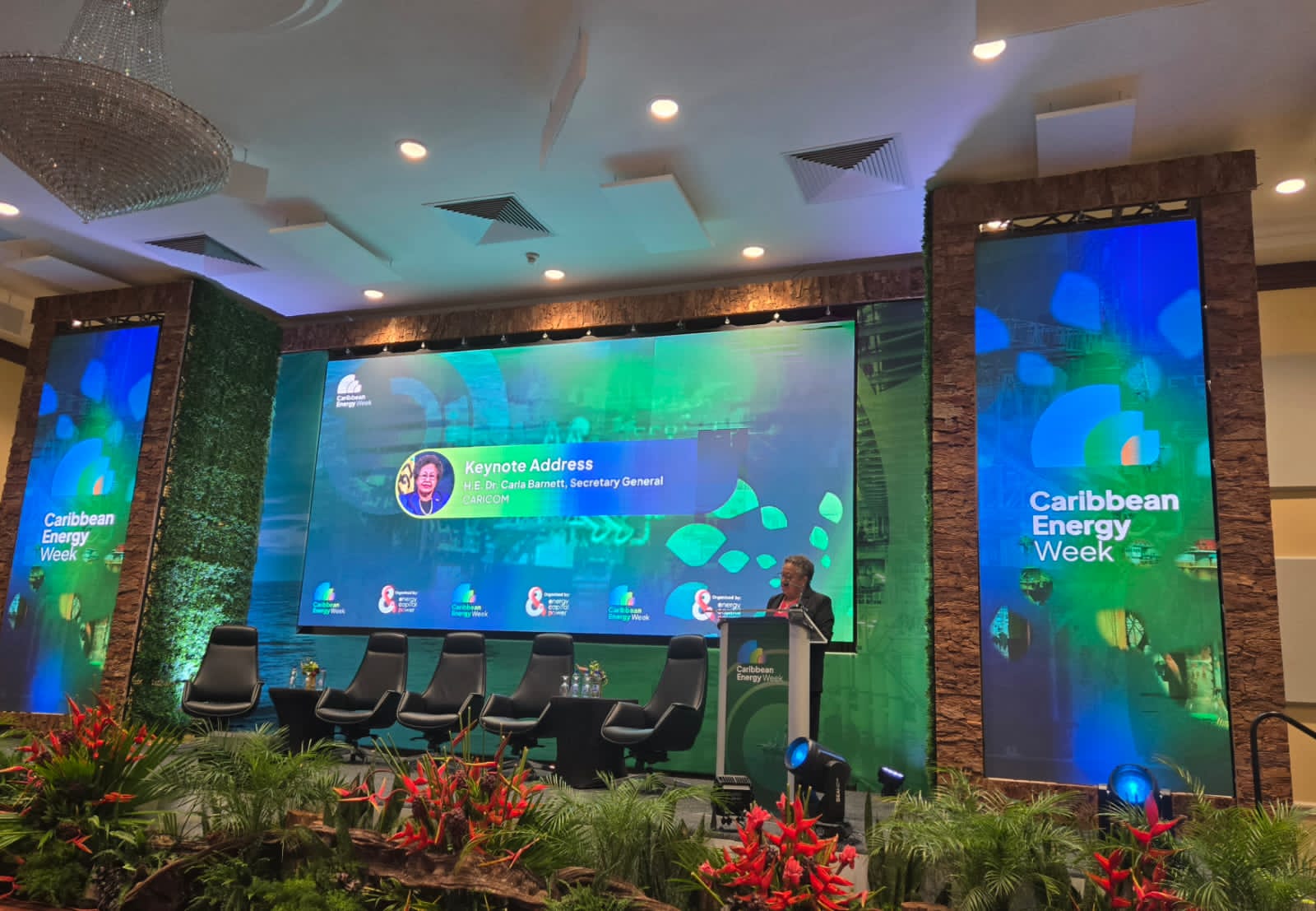
On 31 March Dr Carla Barnett, CARICOM Secretary-General, opened her keynote at Caribbean Energy Week (CEW) 2026 in Paramaribo by offering heartfelt condolences on the passing of former Suriname President Chandrikapersad Santokhi, recalling his leadership during CARICOM’s pivotal meetings in 2022.
Highlighting the CEW 2026 theme “Leveraging Energy Diversity Across the Caribbean,” she underscored the Region’s rich mix of hydrocarbons, natural gas, solar, wind, hydroelectric, and geothermal resources, noting an estimated renewable potential of 10,750 megawatts. This diversity, she stressed, is a strategic advantage that can drive innovation, investment, and cooperation across Member States.
Dr Barnett pointed to recent offshore discoveries in Guyana and Suriname, Trinidad and Tobago’s longstanding expertise, and emerging renewable initiatives in Barbados, Belize, and Jamaica as evidence of the Caribbean’s dynamic energy landscape. She emphasised that energy is now recognised as a driver of resilience and competitiveness, not just an economic sector. Collaboration within CARICOM and with global partners was presented as essential for scaling infrastructure, financing, and human resource development. She urged participants to carry forward the momentum from Caribbean Energy Week into CARICOM Energy Month later in 2026, reinforcing the message that the Region must lead confidently in the global energy transition by building resilient systems, mobilising capital, and nurturing local talent.
Please read her complete keynote address below:
[I would like to deviate] from my prepared remarks and simply share profound condolences from the Caribbean Community on the passing of former President Chandrikapersad Santokhi, who was the Chair of CARICOM when we had very important meetings here in Suriname in 2022. We express our condolences to the Government and people of Suriname and of course to his family and his close friends. May he rest in peace.
It is a distinct honour to join you at Caribbean Energy Week 2026, here in the beautiful city of Paramaribo. We gather not simply as participants in a conference, but as partners shaping the Caribbean’s energy future. I extend my commendations to the organisers of this important gathering, which provides a platform that brings key stakeholders together to engage on the future of energy in our Region.
The theme of this event, “Leveraging Energy Diversity Across the Caribbean” captures both our present reality and the promise of our collective future. The Caribbean region is endowed with a remarkable diversity of energy resources and capabilities, including hydrocarbons, natural gas, solar, wind, hydroelectric power, and geothermal energy.
The combined estimated renewable energy potential in the Region stands at, I am advised, 10,750 Megawatts, and emerging carbon markets indicate that our energy landscape is both dynamic and evolving. This diversity is a distinct advantage. It presents opportunities for innovation, investment, and regional cooperation that can help drive sustainable development across our Member States.
In recent years, the global energy community has increasingly turned its attention to the Caribbean. Major offshore discoveries in Guyana and Suriname have reshaped energy conversations. Trinidad and Tobago continues to demonstrate the enduring value of technical expertise and industrial capacity built through decades of natural gas development. Grenada is emerging as a promising frontier basin and Jamaica recently completed a surface geo-chemistry survey exploratory expedition.
At the same time, other countries throughout the Region, such as Barbados, Belize, and Guyana, are accelerating the deployment of renewable energy, modernising electricity systems, and pursuing reforms that strengthen energy security and affordability. These developments signal the important truth, that energy in the Caribbean is no longer viewed solely as a sector of economic activity. It is increasingly recognised as a strategic driver of resilience, competitiveness, and long-term development.
Caribbean Energy Week 2026 reflects this broader perspective. It brings together a diverse community of policymakers, investors, engineers, academics, and development partners to exchange insights, strengthen partnerships, and identify pathways for investment in the next generation of energy projects.
This highlights the central message that collaboration is essential to our success. Whether the focus is cross-border gas development, regional supply chains, shared infrastructure corridors, renewable integration, or harmonised regulatory frameworks, the Caribbean’s competitive advantage will increasingly depend on our ability to work together.
In this regard, dialogue that extends beyond the Region is equally important. Initiatives such as the Executive Leadership Dialogue and the Atlantic Basin Business Forum recognise that the Caribbean’s energy future is linked to broader partnerships with Africa, Latin America, and global capital markets. Such partnerships will be vital as we expand infrastructure, strengthen financing frameworks, and scale emerging energy technologies.
These efforts align closely with CARICOM’s ongoing energy transition agenda, which supports Member States in advancing sustainable and resilient energy systems. CARICOM is also developing a regional financing strategy to mobilise public and private capital for scaling renewable energy and energy efficiency. This initiative will broaden access to affordable and concessionary financing, promote innovative financial instruments, and strengthen Member States’ capacity to develop bankable projects. It aims to enhance energy security, reduce emissions, and foster climate‑resilient energy growth.
Yet infrastructure and financing alone will not determine our success. Equally critical is the development of our human resources. If the Caribbean is to realise the full value of its energy resources, we must ensure that our engineers, geologists, economists, regulators, and entrepreneurs have access to and develop the skills and opportunities necessary to lead this transformation. In this way, long-term benefits of energy development remain within our economies.
We must also remain mindful of the unique vulnerabilities faced by many of our small states, such as exposure to climate change, reliance on imported fuels, and the urgent need for modern, resilient infrastructure. These underscore the importance of innovation and forward-looking policy.
Discussions taking place during this week on decarbonising Caribbean power systems, and advancing geothermal development, offshore wind, hydrogen opportunities, and blue carbon markets reflect the Caribbean’s growing determination to actively participate in the global energy transition. And let us be clear, energy transition means mapping the way to diversify our energy platform, it does not necessarily mean exchanging one for the other.
This week’s activities which emphasise practical engagement between project developers, governments, and financiers, underline a fundamental principle: energy unlocks development, but investment unlocks energy. The participation of development finance institutions, multilateral banks, regional lenders, and private investors signals growing confidence in the Caribbean’s potential. Our collective responsibility is to continue strengthening the enabling environment through clear regulatory frameworks, transparent institutions, bankable project pipelines, and effective local content strategies that ensure development benefits are broadly shared.
The conversations begun here should ripple far beyond this conference hall. Every exchange of ideas, every partnership formed, and every commitment made brings us closer to a shared regional vision that supports sustainable growth and strengthens energy security, economic diversification, and regional cooperation.
As we look forward to the annual observance of CARICOM Energy Month, which will be the month of November 2026, I encourage us to carry forward the momentum being created this week. The insights, relationships, and opportunities emerging from this forum should reinforce collaboration among Member States, broaden our partnerships, and collectively advance solutions that respond to both the challenges and the immense possibilities of our evolving energy landscape.
Together, we can ensure that our Region, all of our Member States and all in the Caribbean basin area, not only adapts to a changing global environment but leads with confidence, with vision, and with harmony.
Thank you very much, ladies and gentlemen.