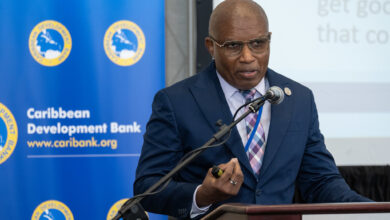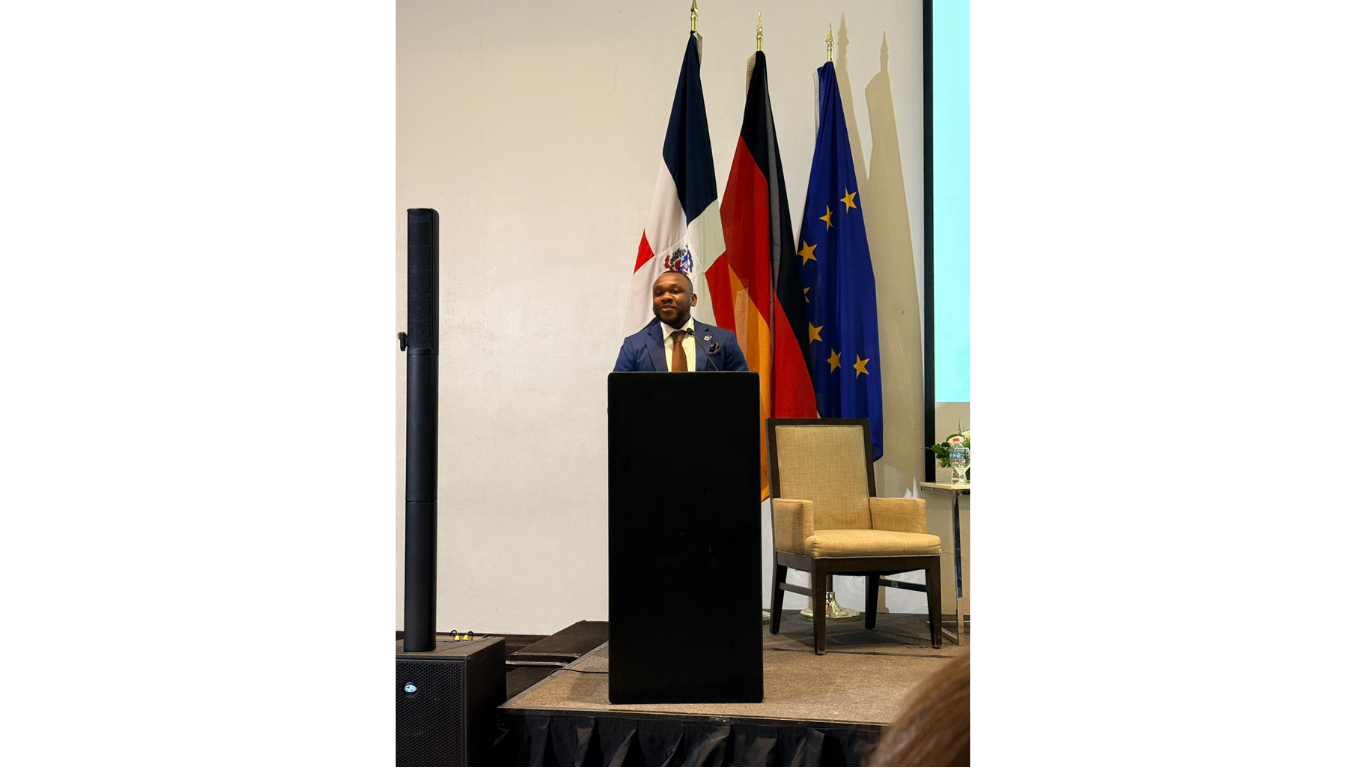
Joel Richards, Director of External Trade at the CARICOM Secretariat, delivered a powerful call to action at the inaugural German Business Forum for Latin America and the Caribbean: urging German partners to view the Caribbean through the lens of opportunity, Caribbean states to become investment-ready and coordinated, and the Forum itself to move decisively from “conversation to commitment, declaration to deal-making, and aspiration to action.”
Richards stressed that this inaugural gathering must mark the beginning of a lasting partnership, forged in serious times. He highlighted the fracturing of the rules-based international order, noting that trade weaponisation, economic nationalism, and supply chain disruptions are reshaping the global economy. Small Island Developing States (SIDS), he warned, are among the most vulnerable, making strategic alliances with Germany essential.
He underscored the Caribbean’s strategic significance as a vital maritime corridor and a Region of nearly 50 million people, rich in diversity but exposed to climate change, financing challenges, and geopolitical pressures. Diversifying partnerships with Germany, he said, is not a diplomatic nicety but a strategic imperative.
He emphasised Germany’s strengths in renewable energy, precision manufacturing, infrastructure, and climate finance, noting their transformative potential for Caribbean economies. At the same time, he highlighted the Caribbean’s market access, investment opportunities, and resilience as assets for German partners.
The Director reaffirmed that the Caribbean and Germany must seize this moment to build partnerships that are mutual, strategic, and future-focused, ensuring resilience and prosperity for both sides.
Please read his complete remarks below.
THE WORLD WE NOW INHABIT
The world that many of us grew up believing in — a world anchored by multilateral institutions, governed by predictable rules, and oriented toward cooperative solutions — is under extraordinary strain. The rules-based international order, painstakingly constructed from the ashes of the Second World War, is fracturing before our eyes.
We see it in, inter alia, the weaponization of trade, in the erosion of multilateral consensus, and in growing economic nationalism. The tremors are geopolitical. But the aftershocks are deeply economic. Supply chains are being redrawn. Trade patterns are being disrupted. Development finance is being redirected. And small states, including Small Island Developing States (SIDS) which have the least capacity to absorb shocks and the fewest alternatives at their disposal, are being asked to navigate an increasingly hostile and unpredictable global environment.
This is precisely why this Forum matters so much because among other things, it will provide an opportunity for the Caribbean and Germany to shore up our bilateral relationship against the backdrop of global disruption.
SMALL IN SIZE, STRATEGIC IN SIGNIFICANCE
Allow me to speak directly about the Caribbean.
Too often, when the world looks at the Caribbean, it sees sun, sea, and sand. It sees tourism destinations. It sees small economies with small voices. What the world too rarely sees is what those of us who know this region understand deeply: that the Caribbean is one of the most strategically significant sub-regions on the planet.
The Caribbean Sea is one of the world’s most vital maritime corridors. It sits at the crossroads of the Atlantic and Pacific worlds. It is the gateway through which vast quantities of global trade flow. It is home to nearly fifty million people across more than thirty territories — people of extraordinary resilience, creativity, and ambition. It is a region of remarkable linguistic and cultural diversity, connecting Latin America, Europe, Africa, Asia, and North America in ways that are unique in the world.
And yet, the Caribbean is also a region of profound vulnerability. Our small island states are disproportionately exposed to climate change, to natural disasters, to commodity price volatility, to the whims of major powers, and to the chronic underfunding of our development needs. Many of our countries are classified as middle-income states and therefore denied concessional financing, even as we face existential threats that no middle-income classification was ever designed to capture.
This is why diversifying our partnerships, and deepening, broadening, and fortifying our relationships with partners such as Germany is not merely a diplomatic nicety. It is a strategic imperative of the first order.
CARICOM-GERMANY BILATERAL RELATIONS
CARICOM and Germany formally established relations in 2008. This marked the beginning of a strong bilateral partnership that has since flourished. Germany has established embassies in three (3) CARICOM Member States: Haiti, Jamaica, and Trinidad and Tobago. As an EU member state, Germany interacts with CARICOM states via the EU-Caribbean Forum (CARIFORUM), EU-Organisation of African Caribbean and Pacific States (OACPS), and EU-Latin American and Caribbean (LAC) frameworks.
In terms of trade, the bilateral trade between CARICOM and Germany has been on an upward trajectory over the past five years. From 2020-2025, CARICOM’s exports to Germany increased by approximately 532%, from just over US$81.5 million in 2020 to roughly US$516.1 million in 2025. Major exports include mineral fuels and oils; chemicals; aluminium ores and concentrates; pearls and precious or semi-precious stones; and beverages and spirits.
Germany has also seen significant export growth to CARICOM, achieving a growth rate of approximately 489.5% between 2020 and 2025. Major imports from Germany include ships and boats, machinery and mechanical appliances, vehicles, pharmaceuticals, and optical, medical and surgical instruments. The dynamism in trade between CARICOM and Germany is likely a sign that the Economic Partnership Agreement, concluded between CARIFORUM and the EU, is having an impact.
Beyond trade, CARICOM and Germany also enjoy robust technical cooperation activities. Germany’s development cooperation in the Caribbean focuses mainly on priority areas such as climate resilience, renewable energy, biodiversity protection, and sustainable economic development.
Since 2008, the Federal Government of Germany has provided more than Twenty-Three Million Euros (€23,000,000.00) of technical assistance toward the sustainable energy sector within CARICOM through a number of programmes.
Recently, CARICOM and Germany concluded an Implementation Agreement for six projects amounting to at Thirty-One Million, Nine Hundred and Ten Thousand Euros (€31,910,000.00). The projects cover biodiversity; circular economy; blue economy; climate change; sustainable energy; and biowaste (including organic waste and sargassum).
WHAT GERMANY BRINGS TO THE CARIBBEAN TABLE
It is natural for the Caribbean to view Germany as a strategic trade and development partner. Germany is a world leader in renewable energy technology and has become a global pioneer in solar, wind, hydrogen, and energy storage innovation. For Caribbean island states that currently import over 80 percent of their energy in the form of fossil fuels, at enormous cost to our economies and our balance of payments, Germany’s expertise in clean energy transition is nothing short of transformational in its potential.
Imagine for a moment what German engineering, German technology, and German investment could do for Caribbean energy independence. Imagine the fiscal space that would open up when governments are no longer hemorrhaging foreign exchange on fuel imports. Imagine the competitive advantage for Caribbean industry and tourism when energy costs fall and reliability rises. This is not fantasy. This is an achievable reality if we build the right partnerships.
Germany is also a world leader in precision manufacturing, industrial efficiency, and the digital transformation of industry. CARICOM has recently approved an Industrial Policy for the Region, consistent with our ambition to add more value to what we produce. German know-how in smart manufacturing, in agri-processing, in the digitalization of supply chains, and in quality standards and certification could be leveraged to help Caribbean producers compete not just regionally, but globally.
Furthermore, German companies are known worldwide for engineering excellence in infrastructure, in water management, in waste management, in transportation systems. These are areas of acute need across the Caribbean. German firms can bring not just capital, but competence, and in small states where the margin for error is narrow and the cost of failure is high, competence is arguably more valuable than capital alone.
Germany also leads in climate finance, green bonds, and sustainable investment frameworks. As Caribbean countries work to access climate finance, German institutions and the broader German financial ecosystem, can be powerful allies in unlocking the resources our region desperately needs.
WHAT THE CARIBBEAN BRINGS TO GERMANY
Let this not be a conversation about what we need from Germany. Let it also be a conversation about what we offer in return because partnership, to be sustainable, must be mutual.
The Caribbean offers access. Our region sits at the nexus of the Americas, with preferential trade arrangements with the United States, Canada, the United Kingdom, the European Union, and increasingly, with Asia. For German companies seeking to enter Latin American and North American markets, Caribbean territories with their stable legal systems, and strategic location offer compelling entry points.
The Caribbean also offers investment opportunity in high-growth sectors such as the blue economy, renewable energy, digital services, creative industries, medical tourism, and agri-business. These are sectors that align well with German industrial and financial strengths.
The Caribbean also offers something less tangible but no less real which is resilience, innovation, and creativity born of centuries of navigating adversity with limited resources.
A CALL TO ACTION
As I close, let me offer a direct call to action — to the business leaders, government officials, development finance professionals, and policymakers in this room.
First, to our German and European partners: I ask you to look at the Caribbean not through the lens of risk but through the lens of opportunity. I ask you to bring your best — your technology, your expertise, your capital, your companies — and to engage with us as equals, as partners, as friends.
Second, to my Caribbean colleagues: I ask us to do the hard work of making ourselves investment-ready. To streamline our regulatory environments. To ramp up invest in the human capital that will make us attractive partners. To speak with more coordinated voices in our engagement with Germany and Europe. And to think regionally because individually, our small states have limited leverage, but together, as CARICOM, as a Caribbean voice, we are that much more powerful.
Third, to this forum itself: I ask that this inaugural gathering be the first of many and that we move from conversation to commitment, from declaration to deal-making, and from aspiration to action.
###