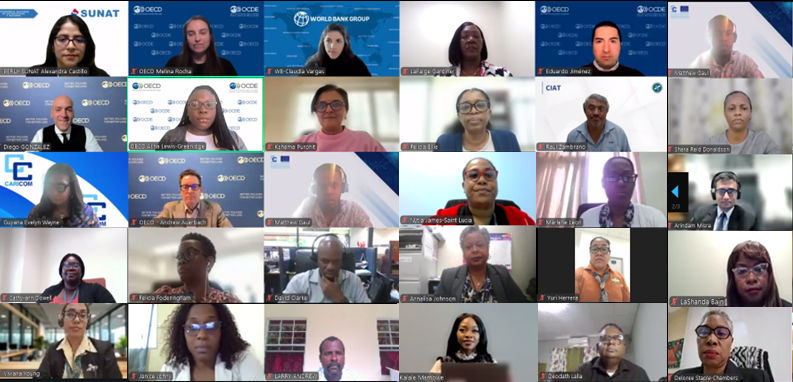
Participants at a recent tax outreach programme underscored the need for a coordinated, inclusive approach to international standards to support the consistent application of national VAT systems and effective taxation of digital services.
The virtual workshop, held on 4 March, was convened under the theme- VAT: Digital Trade, Design and Implementation. It was co-hosted by the Caribbean Community/Caribbean Organisation of Tax Administrators (CARICOM/COTA), the Commonwealth Association of Tax Administrators (CATA), the Inter-American Center of Tax Administrations (CIAT), the International Monetary Fund/Caribbean Regional Technical Assistance Centre (IMF/CARTAC), the World Bank Group (WBG), and the Organisation for Economic Co-operation and Development (OECD).
The one-day session brought together development partners working in the Region to share experiences and streamline capacity-building efforts with the Caribbean to address regional tax priorities. More than 250 participants from 13 Caribbean countries – Antigua and Barbuda, Barbados, The Bahamas, Belize, British Virgin Islands, Dominica, Grenada, Guyana, Jamaica, St. Kitts and Nevis, Saint Lucia, St. Vincent and the Grenadines, and Trinidad and Tobago – representatives from the CARICOM Secretariat, CATA, CIAT, IMF/CARTAC, WBG and OECD, attended the outreach programme.
The digitalisation of the economy has significantly increased cross-border trade and services, creating new challenges for VAT collection worldwide, according to workshop participants, hence the need for deeper coordination.
The workshop outlined key policy tools that are available to secure VAT collection in cross-border transactions and included experience-sharing from Barbados, The Bahamas, and Peru.